

A Global First! TGOOD (300001), the First Stock Listed on the ChiNext Board, Officially Launches Its Groundbreaking AI PowerHouse™
Jun 08, 2026Amid the rapid boom of the AI large-model industry, the intelligent computing sector has entered a new stage characterized by ultra-high-density loads, large-scale cluster deployment, year-round uninterrupted operation, and full-domain zero-carbon development. The traditional multi-level AC power supply architecture is outdated and cumbersome, and is fundamentally mismatched with the core needs of high-density computing power for rapid commissioning, high energy efficiency, high-reliability operation, and efficient utilization of green electricity. This has become a key bottleneck restricting the high-quality development of China's AI computing power industry.
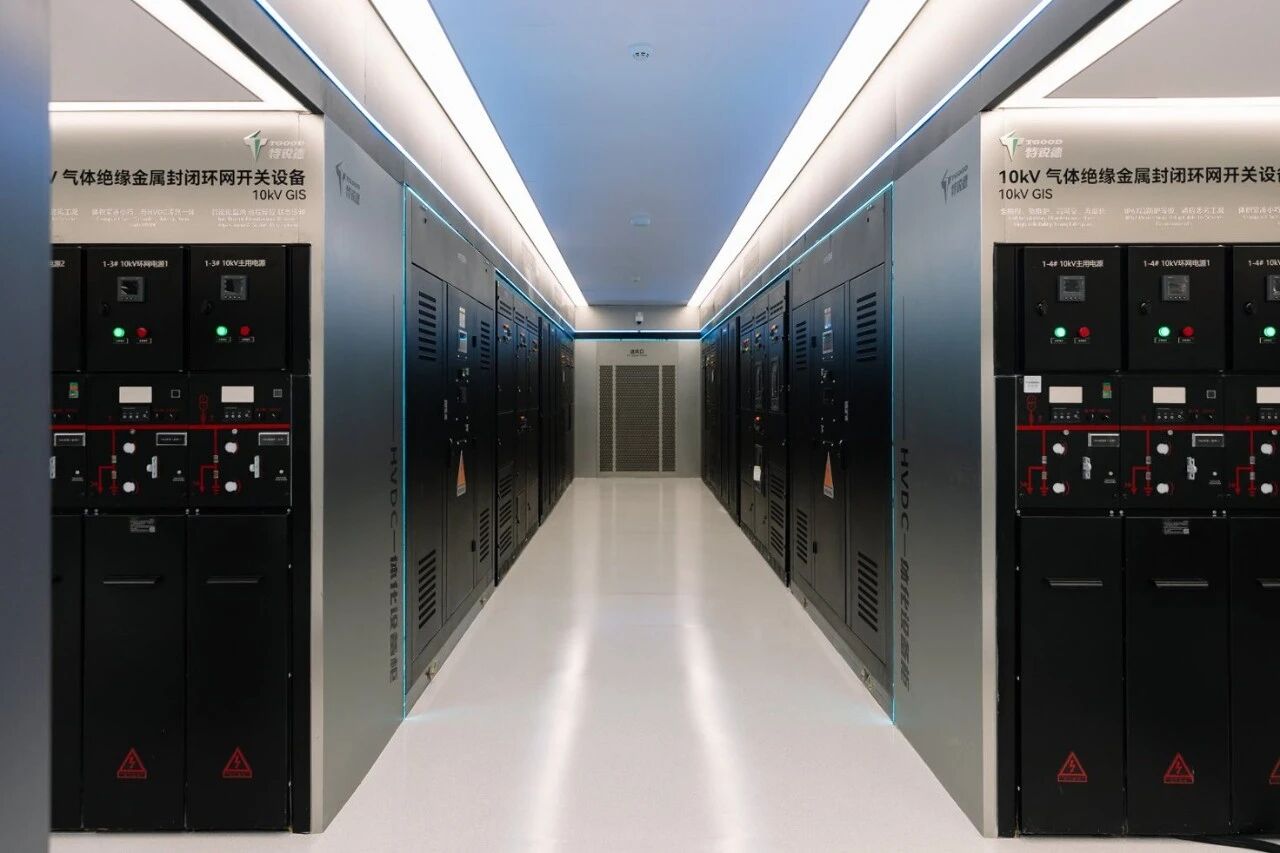
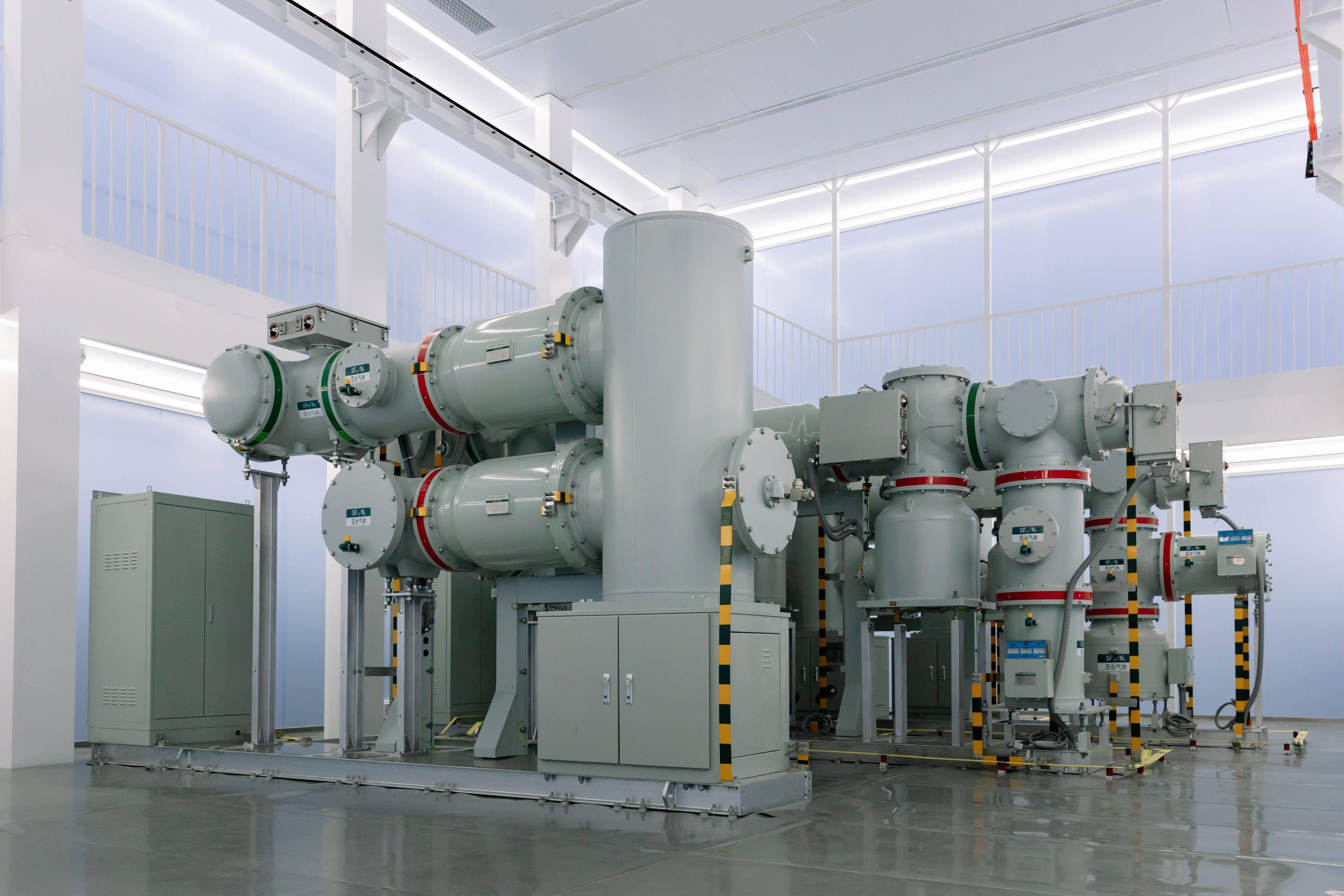
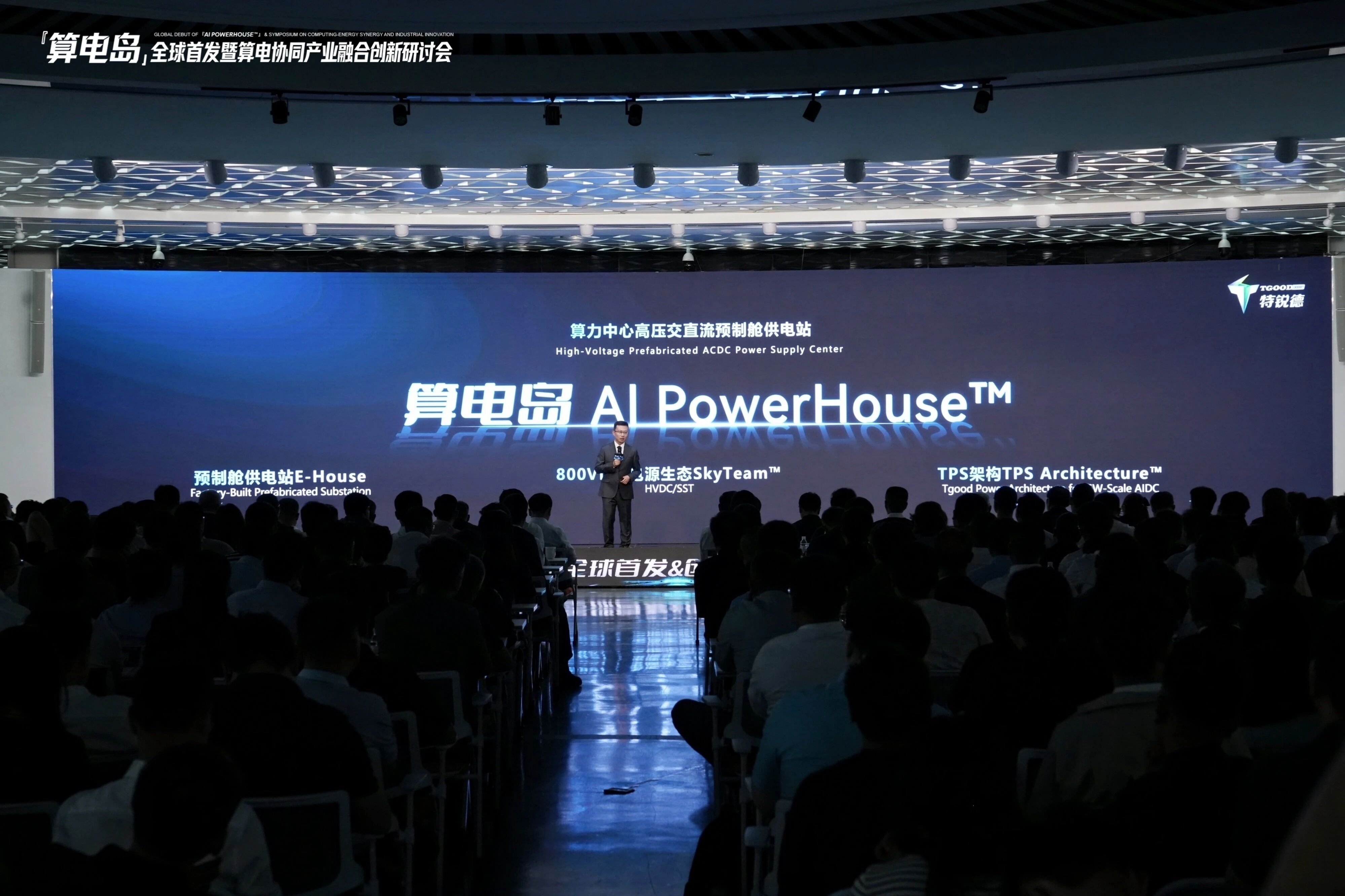
As a global leader in prefabricated substations, TGOOD (300001) has pioneered the world's first high-voltage AC/DC prefabricated substation for computing centers, hereinafter referred to as AI PowerHouse™. It is a large integrated piece of equipment in which high-voltage transformers, GIS, medium-voltage switchgear and busbars, ring main units, SST, microcomputer protection systems, control and communication equipment, and other devices are modularly designed and deeply prefabricated and integrated in the factory according to function and structure, while each on-site module is installed in a building-block manner. This prefabricated substation is directly connected to 110/220kV high-voltage power, and N routes of 800V DC busbars directly supply power to the equipment rooms.
AI PowerHouse™ completely overturns the traditional IDC power supply model and reconstructs the underlying power architecture and construction model for intelligent computing. It marks the industry's formal entry into a new stage featuring direct high-voltage access, direct medium-voltage conversion, direct DC supply, prefabricated integration, SST empowerment, and computing-power coordination. Across six key dimensions—Fast, New, Intelligence, Green, Economy, and Reliable—it creates a top-level integrated and prefabricated energy hub power supply solution for ultra-high-density AI computing power.
I. Fast: From Traditional Civil Construction to Factory-Manufactured prefabricated substation (E-House), delivered in 150 Days.
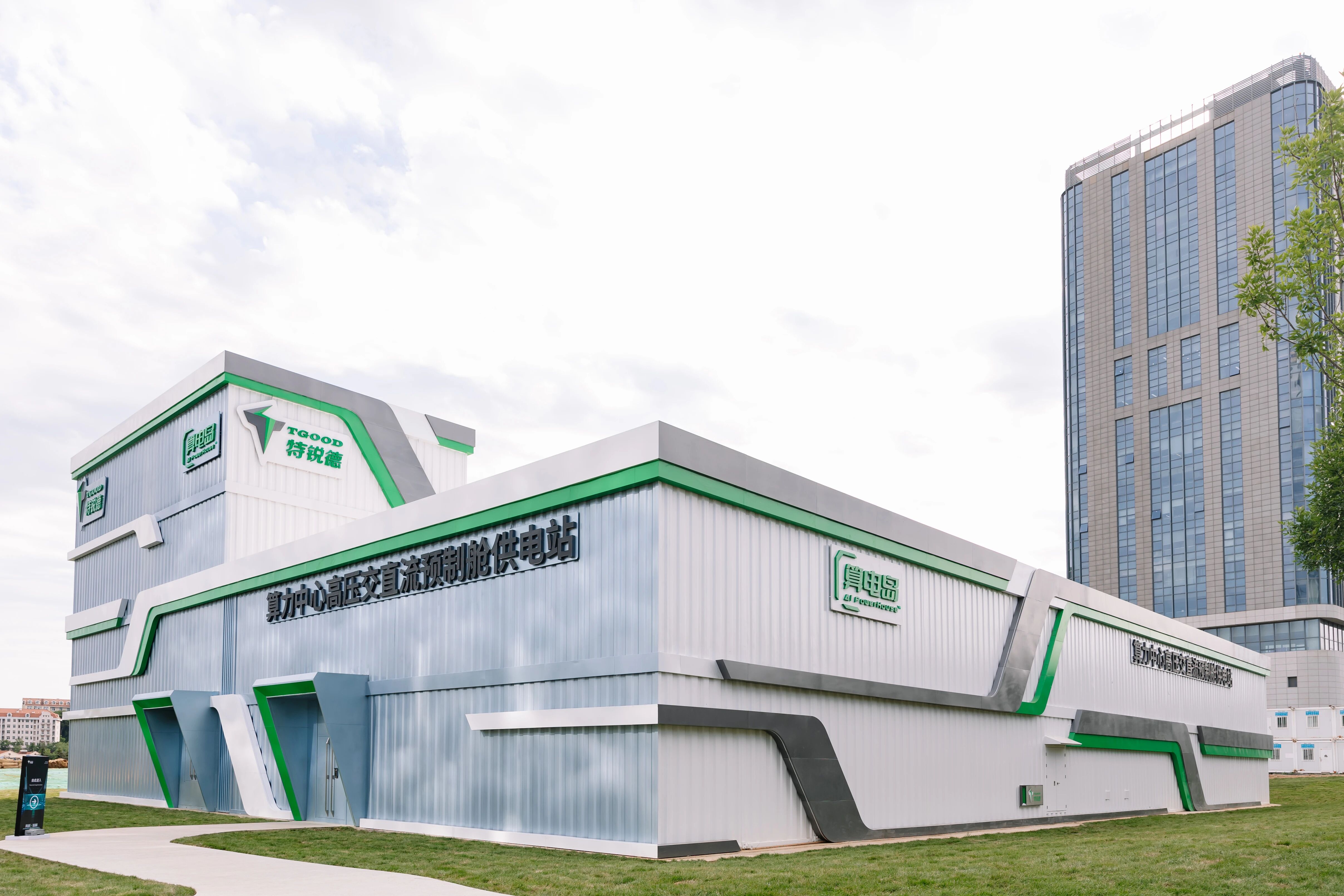
The construction cycle of a traditional civil high-voltage substation is 12–18 months. Its civil and electromechanical works are complex and involve enormous workloads, making it impossible to match the pace of intelligent computing centers that require rapid commissioning and batch expansion within 6–8 months.
TGOOD pioneered an integrated 220kV-800VDC full-link TPS power supply architecture, innovating the substation construction model by comprehensively transforming traditional on-site civil and electromechanical works into standardized, factory-based prefabricated substation manufacturing. The certified product comes standard with dual 110kV/220kV power sources, 3×50MW main transformers with N+1 redundancy, and standard 800V DC output. The entire station includes 167 functional modules covering high voltage, medium voltage, SST, DC distribution, and secondary protection, achieving 100% factory prefabrication and full-system joint commissioning and calibration before delivery. On-site civil work is reduced by 70%, and installation work is reduced by 80%. The cabins are corrosion-resistant, cold-resistant, and sandstorm-resistant, making them suitable for extreme conditions at all types of computing hubs across the country.
Leveraging TGOOD's engineering accumulation and operating experience from thousands of high-voltage prefabricated substations, AI PowerHouse™ can be delivered and energized within five months, supporting phased commissioning, flexible expansion, and off-site reuse in computing-power parks, thereby completely addressing the industry pain point of lagging and slow-deploying traditional power supply construction.
II. New: Upgrading EV Charging from HVDC to SST, industrial Deployment Validation Underway, conversion Efficiency Reaching 98.5%.
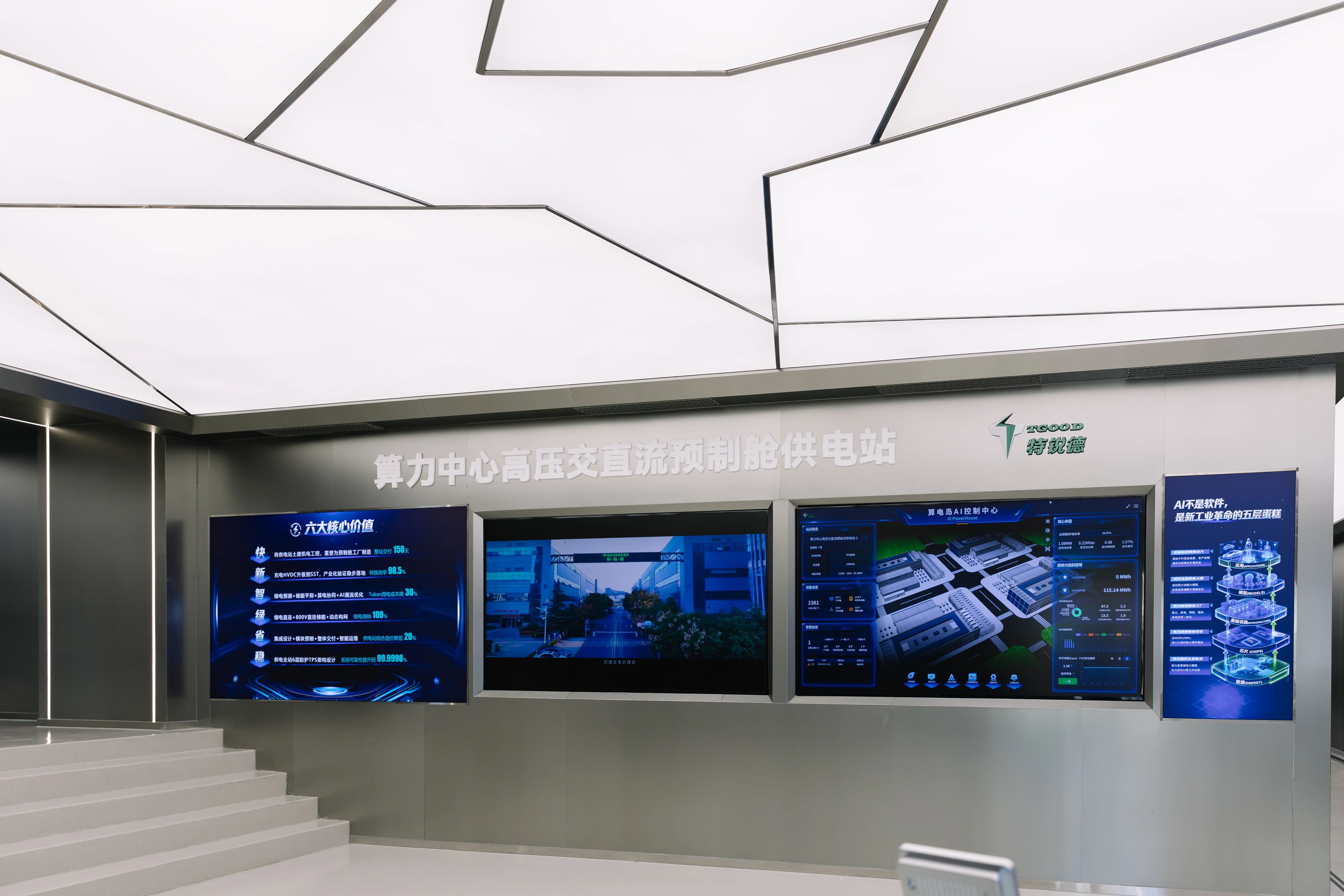
Traditional data centers usually adopt a power supply scheme of 10kV building entry plus UPS or 240V HVDC. This involves multiple power conversion stages, high losses, and low power capacity, making it unable to meet the iterative needs of liquid-cooled ultra-high-density computing loads.
Leveraging TELD's mass-production experience with 2 million silicon carbide modules, the large-scale operating accumulation of 80GW at 4MW per module, as well as industry-leading HVDC and SST production lines and a mature and stable supply chain system, TGOOD has transformed charging HVDC technology into HVDC for computing centers and directly upgraded it to SST. Its self-developed high-voltage SST is expected to complete grid-connected demonstration operation within 2027, enabling direct 220kV high-voltage access and 800V DC output. Based on silicon-carbide high-frequency topology technology, the volume is reduced by 60%, response is achieved at the millisecond level, and conversion efficiency reaches≥98.5%.
After years of iterative refinement and scenario-based testing and optimization by TELD, the third-generation power electronics technology system has enabled the steady industrial validation and implementation of high-voltage power supply and SST technology, with no need for market trial and error. It can perfectly match mainstream 60–100kW liquid-cooled computing racks and is also compatible with future upgrading needs for MW-level ultra-high-density AI computing clusters, enabling robust technological iteration and mature commercial deployment.
III. Intelligence: Green-power forecasting + Energy-storage smoothing + Computing-power coordination + AI power-flow optimization, reduce Token electricity cost by 30%.
In traditional data centers, the energy system and computing system are isolated from each other and adopt a one-way rigid power supply model. They cannot dynamically adjust operating strategies according to fluctuations in new energy output, grid peak-valley loads, and the priority of computing tasks, resulting in industry-wide problems such as low green power utilization, delayed energy storage dispatching, and inefficient coordination between computing and electricity.
TGOOD's innovative AI PowerHouse™ draws on TELD's digital modeling and control-platform technologies accumulated in orderly charging, vehicle-grid interaction, microgrids, and virtual power plants to build a dedicated AI platform for precise computing-power coordination in computing centers. It establishes three core intelligent agents: green-power forecasting, energy-storage smoothing, and AI power-flow optimization. The system can perceive, with millisecond-level precision, changes in wind and solar output, grid load conditions, and remaining energy-storage capacity, and can complete intelligent load allocation, flexible regulation, and dynamic migration in combination with the priorities of computing tasks.
During periods of abundant green power generation, the system proactively increases flexible computing tasks such as data cleaning and model pre-training to maximize the consumption of new energy. During grid peak periods or times of wind and solar fluctuation, it intelligently lowers non-core computing tasks and coordinates with energy storage and supercapacitors to quickly smooth fluctuations in computing demand and electricity supply and stabilize busbar power supply, thereby comprehensively ensuring the uninterrupted operation of high-value businesses such as core AI training and real-time computing. In this way, AI PowerHouse™ truly realizes a new paradigm of precise Computing-power coordination in which electricity guarantees computing power and computing power coordinates with electricity.
Through direct green power connection, energy-storage peak shaving and valley filling, Computing-power coordination, reduced depreciation, lower energy consumption, and intelligent operation and maintenance, AI PowerHouse™ reduces Token electricity cost by 30%, benefiting users' Token consumption.
IV. Green: Direct Green Power Integration + 800V Direct-Coupled Energy Storage + Dynamic Grid-Forming Technology, achieving 100% Green Power Consumption
Traditional data centers face complex renewable energy access pathways, high losses from multi-stage power conversion, weak voltage stabilization support from energy storage systems, poor adaptability to islanded operation, difficulties in implementing zero-carbon development, and relatively low green power utilization.
The TPS power supply architecture of AI PowerHouse™ integrates three core green technologies—direct green power integration, 800V direct-coupled energy storage, and dynamic grid-forming technology—to build a full-domain, highly efficient, zero-carbon power supply system. Wind and photovoltaic power can also be directly integrated into the 800V DC bus, eliminating multi-stage AC/DC conversion and redundant losses and enabling 100% efficient local consumption of renewable energy. The 800V direct-coupled energy storage system has a response time of≤10 ms and supports bidirectional dispatch of energy storage clusters, as well as rapid voltage stabilization and peak shaving.
Leveraging advanced dynamic grid-forming technology, AI PowerHouse™ can independently establish voltage and frequency support, with excellent grid adaptability and stable islanded operation capability, significantly improving the safety of renewable energy grid connection and the stability of renewable energy consumption. Through station-wide AI power-flow optimization, the green power utilization rate reaches 85%–90%, turning policy-driven zero-carbon targets into normalized operational advantages for projects.
V. Economy: Integrated Design + Modular Prefabrication + Turnkey Delivery + Intelligent O&M, reducing Total Power Station Cost by 20%
Traditional data center power supply solutions suffer from a wide variety of equipment categories, long supply chains, scattered equipment deployment, difficulty in standardizing interfaces, and lengthy on-site commissioning cycles. As a result, construction, installation, and operation and maintenance costs remain high, leading to elevated overall investment costs.
Relying on the integrated advantages of self-developed and self-manufactured full-industry-chain high-voltage prefabricated substations, as well as the technological accumulation and operational validation from 2,060 commissioned 110kV/220kV high-voltage prefabricated substations, TGOOD possesses top-tier R&D and manufacturing capabilities for core equipment such as high-voltage transformers and GIS. This enables modular manufacturing of high-voltage equipment, SST, DC distribution, control and protection, and intelligent electrical control systems. Through an end-to-end system of integrated design, modular prefabrication, turnkey delivery, and intelligent O&M, AI PowerHouse™ reduces on-site copper usage by 50%, saves 80% in civil construction costs, cuts construction and equipment leasing costs by 70%, and directly lowers the overall power station cost by 20%.
Its digital twin visualization system and five-level layered intelligent control architecture enable fully unattended operation, early fault prediction, and refined energy consumption management, reducing labor costs for operation and maintenance by 40%.
VI. Reliable: Full-Stack Six-Layer Protection TPS Architecture, raising System Reliability to 99.9998%
AI large-model training and supercomputing parallel processing place extremely stringent requirements on power supply stability and continuity. Even minor voltage fluctuations or momentary power faults can interrupt and restart computing tasks, resulting in enormous economic losses. Traditional power supply systems can only achieve 99.995% reliability, which is insufficient to meet the financial-grade operating standards of top-tier intelligent computing centers.
TGOOD has innovatively built a full-stack, six-layer TPS protection architecture, providing comprehensive safety protection across the device, module, system, link, station, and grid levels. AI PowerHouse™ adopts a full-link 2N/N+1 redundancy design, with N+1 redundant backup for core power devices. Its military-grade cabin structure provides corrosion resistance, moisture resistance, and seismic resistance up to intensity level 9, enabling adaptation to a wide range of extreme operating conditions at computing hubs.
Leveraging grid-level fault isolation and millisecond-level intelligent self-recovery and reconfiguration technology, together with the coordinated voltage stabilization protection of hybrid energy storage combining supercapacitors and lithium batteries, AI PowerHouse™ comprehensively withstands external grid disturbances, instantaneous GPU load shocks, and equipment failures. System power supply reliability is steadily raised to the financial-grade standard of 99.9998%, building a robust power fortress for the safe and stable operation of ultra-high-density AI computing power.
TGOOD has established six core advantages—Fast, New, Intelligence, Green, Economy, and Reliable—and is the only company in the industry with full-chain R&D and manufacturing capabilities covering high-voltage transformers, GIS, medium-voltage switchgear, SST, computing-power coordination control platforms, and high-voltage prefabricated substations. It has opened up a complete closed loop encompassing high-voltage grid access, direct high-voltage DC supply, full green power consumption, intelligent energy storage dispatch, deep coordination between computing and power, and full-lifecycle intelligent O&M, thereby fundamentally reconstructing the underlying rules of intelligent computing power systems. The product fully adapts to current liquid-cooled high-density computing scenarios and future full-domain zero-carbon supercomputing clusters, providing a replicable, scalable, high-safety, high-efficiency, and low-cost domestically developed power foundation for the national computing hubs under the "Eastern Data, Western Computing" strategy, and helping China's AI computing power industry overcome its energy development bottlenecks.
Empowering Digital China with Indigenous Hard-Core Power Technology
Over the next three years, the country's eight national computing hubs will enter a golden period of concentrated commissioning and large-scale expansion. TGOOD's "High-Voltage AC/DC Prefabricated Substation for Computing Centers"—AI PowerHouse™—has established six leading technological advantages, full-stack self-developed capabilities, a five-month rapid delivery advantage, and a full-lifecycle support system.
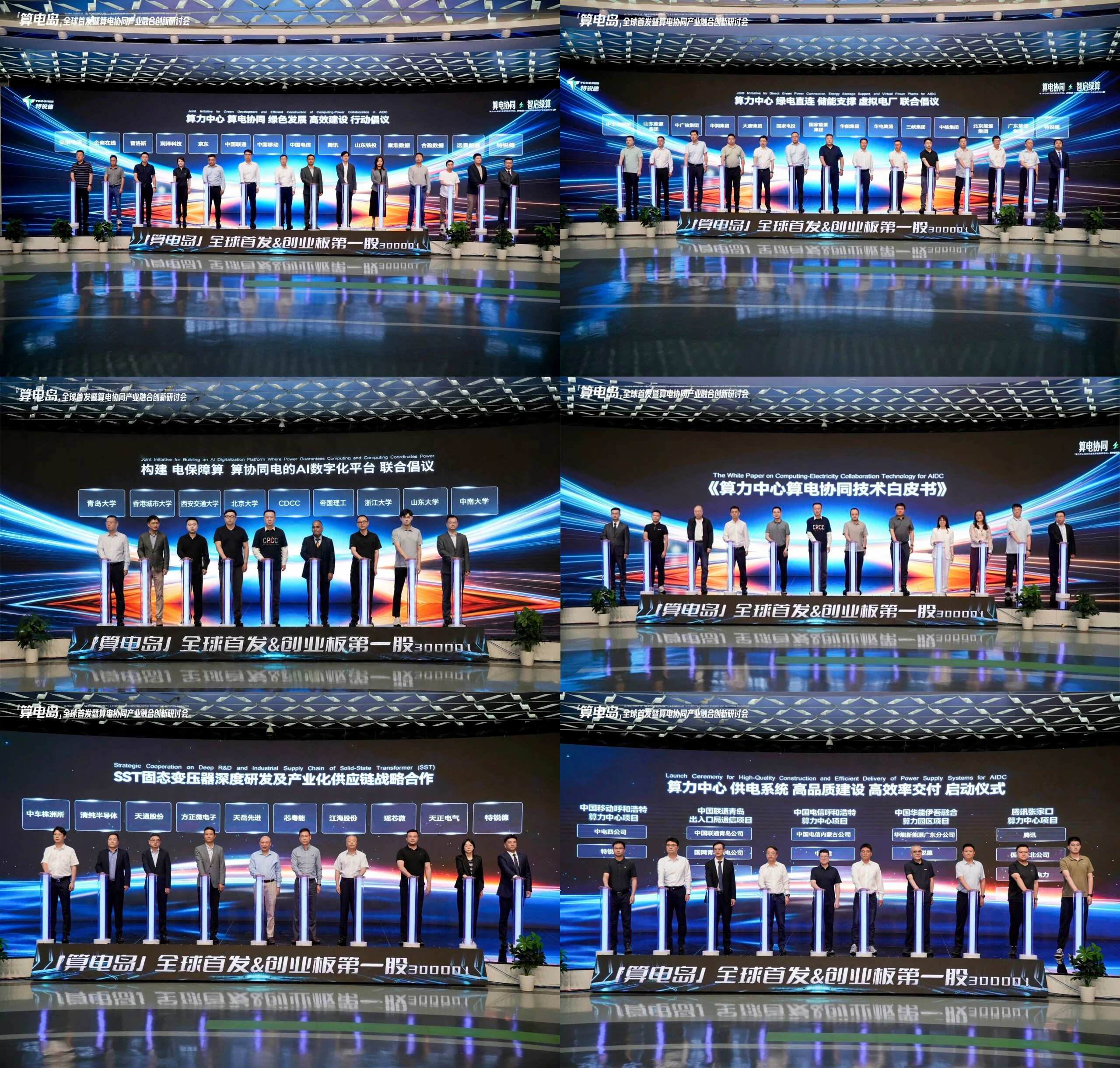
At this launch event, taking the overall development of Digital China as the guiding vision, the China Data Center Committee (CDCC), together with the China Electricity Council (CEC), TGOOD, China Mobile, China Telecom, China Unicom, Tencent, JD.com, Shandong Railway Investment Co., Ltd., Range Technology, Chindata, GLP, Heying Data and Beijing Enterprise Business On Line Digital Communication Technology Co., Ltd. (BCC), jointly released the initiative themed "Compute-Power Coordination, Green Development and Efficient Construction" for computing centers.
To facilitate the energy transition, CDCC, CEC and TGOOD, alongside China Energy Investment Corporation, China Huaneng Group, State Power Investment Corporation (SPIC), China Huadian Corporation, China Datang Corporation, China Three Gorges Corporation, China Resources Holdings, China National Nuclear Corporation (CNNC), China General Nuclear Power Group (CGN), Beijing Energy Group, Shandong Energy Group, Guangdong Energy Group and CRRC Zhuzhou Institute, jointly launched the joint initiative entitled "Direct Green Power Connection, Energy Storage Support and Virtual Power Plants".
To further advance compute-power coordination, CDCC partnered with Imperial College London, Peking University, Zhejiang University, Xi'an Jiaotong University, Shandong University, City University of Hong Kong, Central South University, Qingdao University and TGOOD to propose the joint initiative of building an AI digital platform with the core philosophy of "Power Safeguards Computing, Computing Coordinates with Power".
For the construction of power supply systems for computing centers, CDCC, TGOOD, China Unicom Digital Technology Co., Ltd., China Mobile Group Design Institute Co., Ltd., Beijing Telecom Planning & Design Institute, Huaxin Consulting Design Research Institute Co., Ltd., Modern Design Institute, China Architecture Design Group (CADG), Guangdong Electric Power Design Institute Network Information Branch, GL and Beijing Forever Technology Co., Ltd. jointly initiated the compilation of the White Paper on Compute-Power Coordination Technology for Computing Centers.
For the in-depth R&D and manufacturing of Solid State Transformers (SST), TGOOD has established a robust and resilient industrial supply chain in partnership with Sicc Co., Ltd., Ascenpower Semiconductors Co., Ltd., Shenzhen Founder IC Co., Ltd., Jianghai Electronics Co., Ltd., Tiantong Electronic Co., Ltd., Alkaidsemi (Shanghai) Technologies Corporation, Sichain Semiconductor (Ningbo) Co., Ltd., Zhejiang Tengen Electric Co., Ltd. and CRRC Zhuzhou Institute, so as to consolidate the security foundation for the localized power supply of computing infrastructure in China.
Focusing on the implementation of power infrastructure for computing centers, TGOOD, together with ecosystem partners, jointly launched a ceremony for high-quality construction and high-efficiency delivery of computing power supply for five benchmark computing center projects in Inner Mongolia, Shandong, Xinjiang, Hebei, and other locations.
Based on the strategic layout of national computing hubs, TGOOD and Dawning Information Industry signed a strategic cooperation agreement. With resource sharing and collaborative innovation as the foundation, both parties will implement more high-quality projects, jointly build a high ground for the computing power industry, promote regional economic upgrading, and advance the implementation of an integrated computing-and-power ecosystem, injecting strong momentum into the building of a leading digital nation.
The "High-Voltage AC/DC Prefabricated Substation for Computing Centers"—AI PowerHouse™—built by TGOOD has become a hub for both power and computing power in computing centers. It iteratively upgrades the integrated source-grid-load-storage computing-power coordination system, continues to lead the global upgrading of power supply architectures for computing centers, empowers the development of Digital China with indigenous hard-core power technology, and jointly builds a new ecosystem for computing power energy that is efficient, low-carbon, secure, and intelligent.


